
Allies Until It Costs Something
Real allyship always costs something. Many organisations are quietly deciding not to pay.

A movie dropped on Netflix this weekend “Ladies First” that will sadly resonate with many women in corporate life. Maybe even some men. A caricature of a misogynistic advertising executive offers a performative promotion to a token woman to prevent a client defection. Spoiler alert: he falls, hits his head, and wakes up in a world run by women, where the script is flipped and he becomes the target of the same overt sexism he’d been dispensing for years. He eventually has an epiphany and becomes an ally - but it did take a crack to his head on the pavement to get there.
It is cringey in parts, but the clichés and microaggressions the film showcases are ones many women will recognise and have experienced.
Why is this movie relevant? Ask what any gender equity initiative run in your organsiation costs, not only in budget but political capital, in discomfort, in relationships, and in revenue.
If the answer is nothing, that’s your answer - then it’s gender washing - exactly as in perfromative promotion showcased in the movie.
What Is Gender Washing?
Gender washing, sometimes called femwashing, is performative gender equity. It borrows the aesthetics of inclusion without the follow-through or the systemic change needed to make progress permanent.
It has a recognisable MO exactly the same as the film: a showy announcement followed by silence, usually at the point when sustained effort is required. Here businesses appoint women to visible roles without changing the conditions for those women to thrive. They runs gender equity campaigns externally, while quietly scaling back internal commitments, celebrating Women’s Day with pink cupcakes, only to cut the DEI budget in Q3.
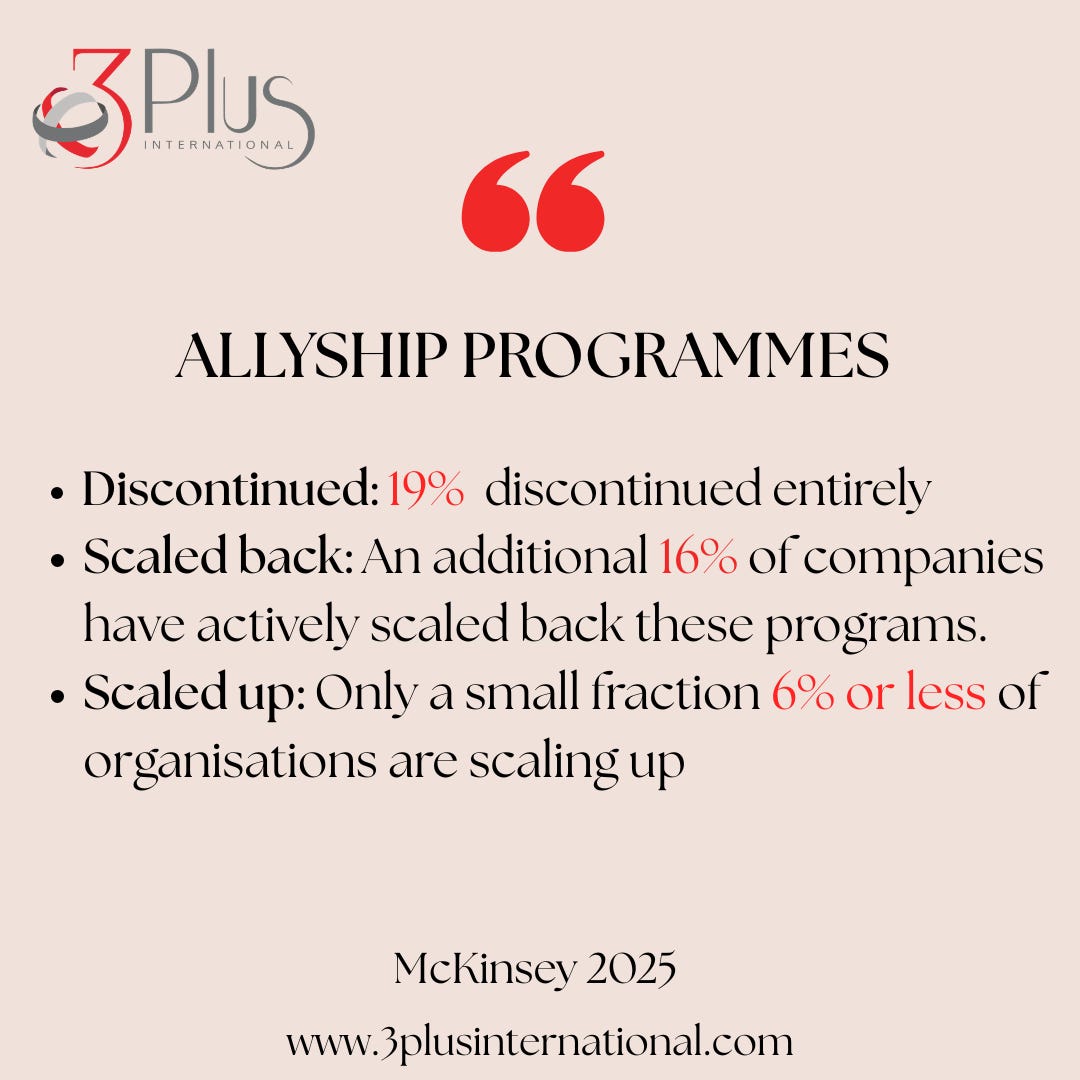
The corporate retreat from gender equity is being well documented. McKinsey’s Women in the Workplace Report 2025 found that organisations are scaling back or discontinuing bias and allyship training at notably high rates.19% have discontinued allyship programmes entirely, with only a fraction scaling up. Women remain underrepresented at every level of the corporate pipeline, holding just 29% of C-suite roles, unchanged from the prior year.
A wider cultural context makes this retreat easier to sustain. According to Ipsos’s International Women’s Day Survey 2025, conducted across 30 countries, 55% of men believe that when it comes to giving women equal rights, things have already gone far enough. When a majority of male leaders, evaluators and decision-makers start from that premise, performative gestures become easier to mistake for genuine progress, and genuine progress becomes easier to deprioritise.
The gap between what is said and what is done is precisely the place where gender washing lives. But even there, the line between washing and genuine allyship is finer than most organisations would like to admit.
The Research That Changes the Framing
A study published in the British Journal of Social Psychology (2026) sheds uncomfortable light on why gender washing is so structurally durable. The research, conducted by Belle Derks, Francesca Manzi, Colette van Laar, and Naomi Ellemers across Utrecht University, the London School of Economics, and KU Leuven, ran five experimental studies involving 887 participants to examine how evaluators assessed leadership candidates who either challenged or reinforced the gender status quo.
The findings are striking with men consistently favouring female candidates over male ones, but only when those women reinforced, rather than challenged, the status quo on gender equality. Female candidates who advocated for gender equality, who rocked the boat, were systematically penalised in evaluations made by male assessors, although female evaluators showed no such preference.
The authors frame this as the strategic trap women face in leadership: fit in by downplaying inequality, or challenge it and reduce your chances of advancement. Men, the study finds, remain the gatekeepers, and they tend to open the gate for women who will not disrupt what lies behind it.
This is the structural logic that makes gender washing so useful to organisations. You can celebrate women leaders loudly while quietly selecting female candidates who will leave the infrastcuture of inequality untouched. The pipeline appears diverse, but the power structure remains unchanged
For women navigating this, the dilemma is real and documented: advocate communally for women’s advancement and your individual prospects suffer. Downplay the inequality around you and you may rise, into a role that will then be used as evidence that equality has already been achieved.
Where Real Allyship Differs
Genuine allyship is structurally different because it involves the transfer of risk from those with more power toward those with less. This involves expenditure of capital whether, political, social, or organisational,
Genuine allies advocate for structural reforms: pay transparency, equitable promotion criteria, parental leave that doesn’t career-penalise women. They speak in rooms where women aren’t present and name the dynamic the research describes, rather than quietly benefiting from it. They understand the authority gap that a man speaking on gender is frequently received as an expert, while a woman speaking on the same topic is received as an activist, a shrill one at that.
The UN Global Compact, draws the same line in its guidance on male allyship: for gender diversity to genuinely take hold, male allyship must move beyond performative gestures into tangible action, championing advancement even when it creates discomfort for those already in power.
There is one further distinction worth naming. Allyship that stops short of structural change doesn’t just fail to help, it can actively harm. Scholars of gender call this benevolent sexism: positioning women as deserving of support and protection, while leaving the conditions that require that support entirely intact. It is presented as advocacy and may pass at first glance, but it reinforces the underlying premise that women are exceptions to be managed, rather than equals operating within a broken system. The warm gesture that never becomes policy is not neutral but the very structure of gender washing in action.
The Cost Test
A useful test: what does this support actually cost because gender washing doesn’t cost anything. Appointing a woman to a leadership role because it looks good, while selecting someone who won’t challenge or change the structure, is a freebie. Running a Women’s Day campaign with no internal policy behind it, is the cost of pink cup cakes and a lunch and learn session.
Real allyship always costs something whether political capital to advocate for pay equity when the people you’re advocating against are peers or superiors. It costs cultural comfort to name the visible points the research highlights, that evaluators may be systematically selecting women who won’t rock the boat, in a room full of said evaluators. Budget is also impacted revenue, possibly, taking funds from other aras of the business. Revenue could be at stake hold the line on gender equity commitments under heavy political pressure to abandon them in some geographies. Allyship challenges relationships when they call out microaggressions or bias, because it’s easier to remain silent
The research from Derks and colleagues makes clear that men are the gatekeepers of masculine-coded organisations, and what they do when no one is watching matters more than what they say when everyone is.

Why This Matters Now
The current political context has made it considerably easier to retreat from gender equity commitments and call the withdrawal prudent. DEI is being politically contested, the backlash is real and loud and penalties potentially severe. IBM losing to the DOJ is case in point. Companies are discovering that the allyship they expressed during more comfortable years was, in many cases, exactly as conditional as the research predicts.
So, the line separating gender washing and the real allyship is under pressure. Most organisations have quietly decided not to pay the costs involved or have stopped the standing order. Who knows if this will be permanent.
If you're an HR or DEI professional who wants to know which side of the line your current practices fall on, 3Plus International has been helping organisations close the gap between policy and practice for over a decade. Start at 3plusinternational.com.